Materials & sleep
Wool or Latex? Comparing Naturepedic’s Natural Fill Options
A pillow is a small piece of engineering disguised as a soft place to put your head. Its filling influences how it gives under pressure, how it holds warmth, and whether its loft can be changed when the first arrangement proves imperfect. Wool and latex approach those questions differently.
Two natural materials, two different ways to rest
At bedtime, material differences become intimate. A pillow may seem a passive object, but it is continually negotiating with the head, neck, shoulder, room temperature, and the sleeper’s changing position. Some fillings yield and settle; others push back. Some invite adjustment by the handful; others arrive with a shape and ask the sleeper to meet it halfway.
Wool and latex are both used in natural bedding, yet they offer markedly different experiences. Wool is a fiber: springy, breathable, and capable of holding air among its strands. Latex is an elastic material made from rubber-tree sap, formed either as a solid core or as smaller pieces that can move within a pillow. One is often associated with a softer, more diffuse cradle; the other with buoyancy and a clearer sensation of support.
In Naturepedic’s pillow range, wool appears as a filling in its own right, while latex is offered in solid and adjustable constructions. Those distinctions matter more than the broad labels. “Wool” does not tell you whether the filling is batting or separate wool puffs, and “latex” does not tell you whether the pillow is a single molded piece or a bag of shredded material. The construction determines much of the feel.
This is not a contest with a universal winner. A pillow that seems pleasantly yielding to one person may feel shapeless to another. A resilient latex pillow may feel supportive to a sleeper who likes a stable surface and too springy to someone who wants the head to sink in. The useful question is not which material is better in the abstract, but which one answers your particular preferences.
What wool feels like beneath the head
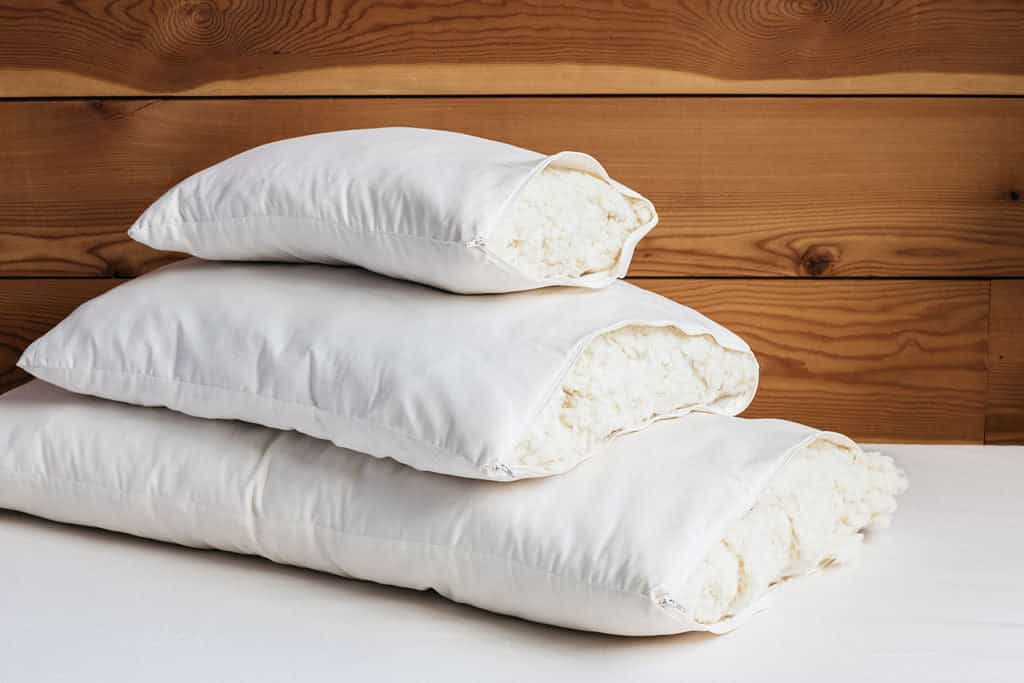
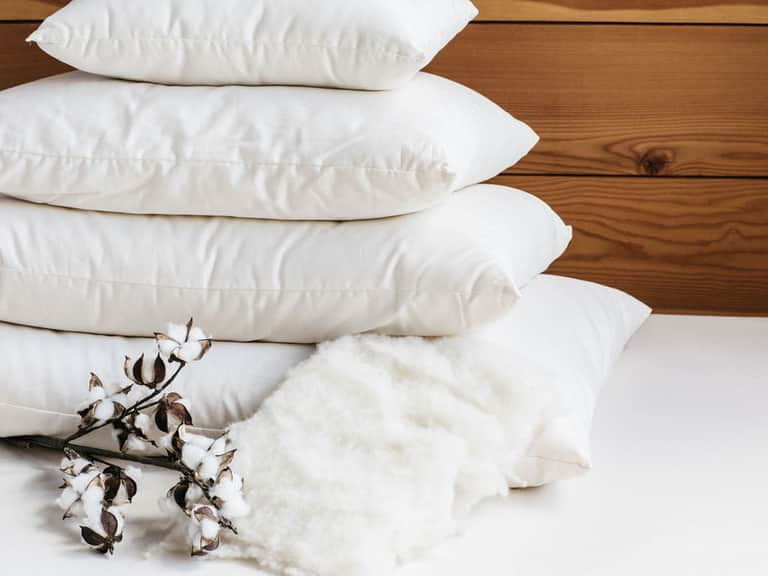
Wool has a quiet complexity. Its fibers curl and overlap, creating small spaces that can hold air. In pillows, that structure can contribute to a cushioned feel without making the material behave exactly like down or a loose synthetic fiber. Depending on the design, wool may be layered as batting or gathered into rounded clusters—sometimes called wool bolus. The former can feel more uniform; the latter can create a more mobile, softly resilient fill.
Naturepedic’s organic wool pillow is described as using wooly bolus. The loose wool clusters are intended to encourage airflow and help the pillow maintain its form. Its outer cotton cover is described as GOTS-certified, and the outer casing is removable and washable. The wool insert, by contrast, is spot-clean only. That division between washable cover and protected core is common in natural-fill pillows: the removable textile takes on the routine work of staying fresh, while the filling is kept away from a full wash cycle.
Wool is also valued for its relationship with heat and moisture. It can take up and release moisture vapor, and the spaces between fibers allow air to circulate. That does not make a wool pillow a temperature-control device, nor does it guarantee that every sleeper will feel cool. The result depends on the pillow’s density, cover fabric, bedroom climate, bedding, and the person sleeping on it. Still, for someone who dislikes the sealed, close sensation of a dense pillow, wool’s fiber structure may be worth considering.
The feel is usually less sharply defined than a molded latex contour. Wool can compress under the weight of the head and then recover to some degree, producing a surface that feels soft but not necessarily weightless. Some wool pillows can be adjusted by removing filling; others are made in a fixed form. Naturepedic’s bolus design is described as maintaining loft, but the particular pillow’s construction and access to its interior should be checked before assuming the fill can be customized.
Wool’s appeal also comes with practical limits. A pillow whose core is spot-clean only requires a protector and a little foresight. It is not the choice for someone who wants to put the entire pillow in a washing machine after every spill. Airing it out and keeping the cover clean can help reduce the need for more involved cleaning, but the care label remains the authority. Natural materials are not exempt from ordinary maintenance.
What latex adds: lift, resilience, and shape
Latex has a different physical character. Instead of a mass of fibers compressing together, a latex core deforms under pressure and pushes back. That springiness is often described as buoyant or responsive. A sleeper may notice that the head is supported without being swallowed by the pillow, and that the surface returns toward its original shape when pressure shifts.
Naturepedic’s solid organic latex pillow is described as a dense, resilient piece of latex, with small pinholes and air channels intended to improve airflow. Its organic cotton cover adds a breathable textile layer, but the core itself remains a single molded structure. This construction gives the pillow a consistent profile. It may suit someone who wants a stable, repeatable feel and does not want loose filling to move around inside the case.
The adjustable latex option makes a different compromise. Rather than one solid core, it uses shredded or cut latex pieces inside a zippered casing. Removing some fill can reduce height; retaining more can create a fuller pillow. This is useful because loft—the pillow’s height under the head—is not an incidental detail. A pillow that is too high or too low can feel uncomfortable, and the right height depends partly on sleep position, shoulder width, mattress firmness, and personal preference.
Adjustability is not the same as effortless customization. Opening a pillow to remove fill can be untidy, and reaching the right loft may take a few nights of trial. The advantage is that the sleeper can change the amount of material rather than accept one fixed height. Once the preferred amount is found, the pillow can be zipped closed and left alone.
Latex is commonly appreciated for its ability to recover after compression. That resilience can help it keep its profile, although durability depends on the latex, construction, use, and care. A solid latex pillow is not typically fluffed in the way a loose fiber pillow may be. An adjustable shredded version can be shifted by movement, but its fill is still intended to provide a responsive support rather than the loose, airy softness associated with down-like materials.
Care differs by construction. Naturepedic’s adjustable latex pillow is described as having a washable outer cover, with the latex insert spot-clean only. It should not be treated as though the entire pillow were ordinary laundry. For the solid pillow, the specific care instructions should be checked rather than inferred from the material alone. In every case, a pillow protector can help limit the work the core must do.
Support is not a single sensation
People often use “support” to mean several different things: firmness, resistance, height, or the ability to keep the neck in a comfortable position. These are related, but not identical. A pillow may feel soft at the surface and still hold the head at a useful height; another may feel firm yet be too tall for a particular sleeper.
Latex generally offers a more immediate sense of resistance. A solid core has a defined shape, while shredded latex can be moved or reduced to change loft. Wool tends to provide a more fibrous, cushioned kind of support. Whether it feels firm or yielding depends on how much wool is packed into the pillow and how it is arranged.
Sleep position offers a starting point, not a prescription. Side sleepers often need enough height to fill the space between the head and mattress, taking shoulder width and mattress softness into account. Back sleepers may prefer a lower or medium loft that supports the curve of the neck without pushing the head forward. Stomach sleepers often find a flatter surface more comfortable, though individual experience varies. A pillow’s label cannot do this arithmetic for you.
For a side sleeper who wants a stable, elevated feel, latex may be appealing, particularly if the fill can be adjusted. For someone who wants a softer, more diffuse cushion and is drawn to natural fibers, wool may be more inviting. But those are tendencies, not guarantees. The best test is to notice the position of the head and neck while lying in the way you normally sleep, rather than judging the pillow only by how it feels in a shop or in your hands.
Temperature and moisture: what materials can—and cannot—do
Natural bedding descriptions often use words like “cooling” with more confidence than a pillow can reasonably support. Wool and latex can influence how air and moisture move around the head, but neither can control the temperature of a bedroom or override a warm duvet, a mattress protector, or a sleeper’s own heat production.
Wool’s crimped fibers create spaces that can hold air, and the fiber can interact with moisture vapor. A wool-filled pillow may therefore feel breathable and less clammy to some people. Its insulation is part of its character: wool does not simply mean “cool.” In a cold room, the same capacity to hold air can contribute to a cozy sensation. The specific density and outer fabric make a difference.
Latex pillows may include perforations or air channels to promote ventilation. Shredded latex can also leave more open space than a solid block, depending on the amount and arrangement of fill. Yet a latex pillow may feel denser than a loose wool pillow, and the cover can affect the surface sensation. If temperature is your main concern, compare the whole construction—not just the name of the filling.
When possible, assess your current sleep setup as a system. A pillowcase made from breathable cotton, a lighter duvet, and a cooler room may matter as much as switching fillings. Keeping a short note about when you feel overheated, and whether the problem occurs at the pillow or across the bed, can help identify what is actually driving discomfort.
Organic claims and the value of specificity
“Natural” and “organic” are not interchangeable terms, and neither one describes every component of a pillow automatically. A pillow can have an organic cotton cover and a different kind of filling; a material may be naturally derived without being certified organic. For readers concerned about sourcing and processing, the useful habit is to look at each component separately: shell, fill, inner casing, and any additional layers.
GOTS, the Global Organic Textile Standard, applies to textiles and includes requirements concerning organic fiber processing and other aspects of production. GOLS, the Global Organic Latex Standard, is associated with organic latex. A certification should be understood in context: check what material and product scope it covers, and do not assume a label on one component certifies every element of the finished pillow.
In Naturepedic’s listed pillow descriptions, the wool option includes a GOTS-certified organic cotton cover, while the adjustable latex pillow is described as using a GOTS-certified cotton cover and latex associated with GOLS or FSC certification. The solid latex pillow is described as organic latex with an organic cotton cover. Because certification language and product specifications can change, it is sensible to verify current details with the manufacturer or the product’s documentation before making a decision.
Certification is one kind of information, not a substitute for the rest. It does not tell you whether the loft will suit your neck, whether the pillow is washable, or whether its feel will be pleasant to you at three in the morning. Material transparency and practical comfort belong in the same conversation.
Care can decide the matter
People sometimes choose a pillow by imagining its first night and forget the years that follow. Care instructions are less glamorous than softness, but they are part of the ownership experience. Wool-filled pillows may need protection from spills and routine soil, especially when the filling itself is not washable. A removable, washable cover can simplify matters, though it does not make the insert machine-washable.
Latex pillows also require care according to their construction. In an adjustable model, the cover may be washable while the fill is restricted to spot cleaning. A solid core may have its own instructions. Heat and direct sunlight can be inappropriate for some latex products, so avoid improvising with a dryer or leaving a pillow in a bright window unless the manufacturer says that is safe.
A pillow protector is a simple, useful layer for either material. It can keep sweat and everyday soil away from the cover and core, and it is generally easier to launder than the pillow itself. Before cleaning, check whether the cover unzips, whether the insert can be removed, and which parts may be washed. If the instructions say spot-clean only, follow that guidance rather than testing the pillow’s limits.
Care also affects sustainability. A material with appealing environmental credentials is not automatically a lower-impact choice if it is discarded quickly because it cannot be maintained or does not suit the sleeper. Choosing a pillow whose care requirements match your habits can be a modest but practical way to extend its useful life.
A practical way to choose
Before comparing labels, identify what you want the pillow to do. Do you prefer a surface that rebounds, or one that feels more softly fibrous? Do you need to adjust the height? Does your current pillow flatten, feel too warm, or simply put your head at an awkward angle? Clear answers make the material question less abstract.
- Consider latex if you want a buoyant, responsive feel, a defined support surface, or an adjustable fill that lets you alter loft.
- Consider wool if you prefer a natural-fiber cushion, value moisture management and airflow, and are comfortable protecting a fill that may require spot cleaning.
- Check construction before relying on a broad material name. Solid latex and shredded latex do not feel the same; wool batting and wool clusters can behave differently.
- Match loft to position while remembering that shoulder width, mattress firmness, and personal comfort also matter.
- Read the care label for the cover and the insert separately. “Washable cover” does not mean “washable pillow.”
- Verify certification scope if organic sourcing is important, and confirm which materials the certificate actually covers.
If you are uncertain, changing one variable at a time is more informative than replacing several parts of the bed together. Give a new pillow a few ordinary nights, when possible, and note whether the height, surface feel, or temperature seems to be the issue. A pillow is judged not by its abstract virtues but by the quiet evidence of repeated use.
The decision, in the end
Wool and latex are not rival answers to the same question so much as different answers to different ones. Wool offers the character of a resilient natural fiber: cushioned, breathable, and dependent on its construction for its final loft. Latex offers a more elastic response: a firmer sense of return, with solid and adjustable forms that serve different preferences.
For Naturepedic’s wool option, the notable details are its wooly bolus fill and washable outer casing paired with a spot-clean-only insert. In the latex range, a solid core offers a stable shape, while an adjustable version gives the sleeper more control over height. None of those features guarantees better sleep; they provide a clearer basis for deciding which experience is more likely to feel right.
It is tempting to make the choice a declaration about health or virtue. A quieter approach is more useful: read the materials, understand the construction, check the care, and pay attention to the position of your own head and neck. The best pillow is not necessarily the most novel, the most natural-sounding, or the most emphatically certified. It is the one that supports a comfortable night without making itself the subject of one.