Pillows · Materials and design
How Sleep and Beyond’s myDual Design Supports Side-Sleeping Alignment
A side sleeper’s pillow has a quiet but consequential task: fill the space between mattress and head without nudging the neck out of line. Sleep and Beyond’s myDual Side Pillow approaches that task with a shaped profile and adjustable wool fill—two features that make it possible to consider support as something fitted, rather than simply chosen off a shelf.
The small geometry of side sleeping
Side sleeping can look uncomplicated from across a bedroom. The sleeper settles on one shoulder, turns the face slightly toward the room, and goes quiet. But the arrangement depends on a small piece of geometry: the distance from the mattress to the side of the head. A pillow that is too low may let the head tip toward the mattress; one that is too high may lift it away. Either mismatch can leave the neck angled for hours.
That distance is not the same for everyone. Shoulder width matters, as does the firmness of the mattress, because a shoulder sinks more deeply into some surfaces than others. The shape of the sleeper’s head and neck, the pillow’s compressibility, and the habit of moving during the night also change how a pillow behaves. “Side sleeper” is a useful starting point, not a complete specification.
The aim is generally a comfortable, reasonably neutral relationship between the head, neck, and spine. It is not a promise that a particular pillow will correct pain, prevent an injury, or produce an ideal posture for every body. Rather, the pillow should provide enough support to keep the head from noticeably sagging or being pushed upward, while remaining comfortable in the position a person can actually maintain.
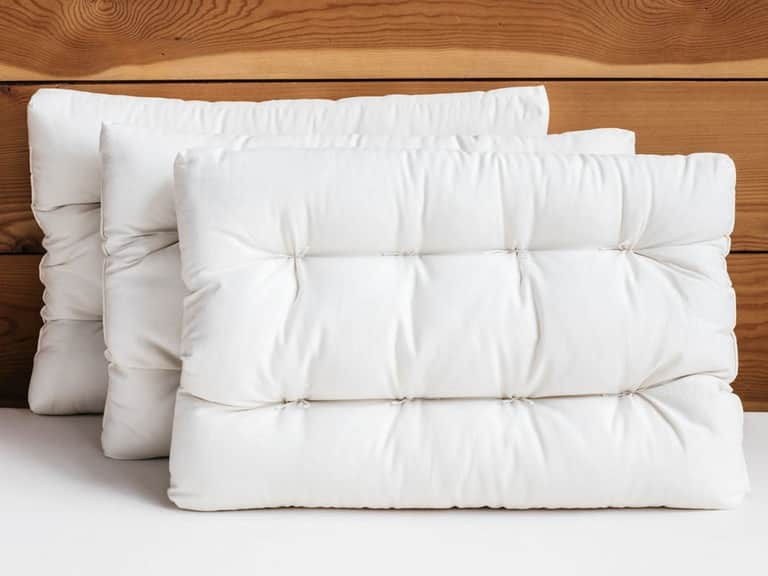
Sleep and Beyond’s myDual Side Pillow offers one design response to this practical puzzle. Its shape is intended to support side sleeping, while its wool-puff filling can be added or removed to change loft. The pillow also has a quilted wool case around the fill and a removable cotton sateen outer case. Those details influence how it is positioned, adjusted, and cared for in everyday use.
A shaped profile, not just a soft surface
Many conventional bed pillows are roughly rectangular and depend on the sleeper to arrange the fill into a useful shape. A shaped pillow begins with a more specific idea of where support should sit. The myDual is designed for side sleepers and described as positionable and bendable, so a user can make small changes to how it meets the head and neck. Its profile may also leave room around some CPAP equipment, depending on the shape of the device and the person’s sleeping position.
That last point is a matter of fit, not treatment. A pillow does not treat sleep apnea, replace a prescribed therapy, or make a CPAP machine unnecessary. For someone already using CPAP, comfort around the mask and hose can matter to the nightly routine, but the setup should continue to be guided by a clinician or sleep specialist. A pillow that works for one mask shape, sleeper, and bed arrangement may not work for another.
With any shaped pillow, the first question is not whether its outline looks specialized. It is whether the shape remains comfortable after the sleeper lies down in a natural position. The head should not have to be held at an awkward angle to make the pillow appear to fit. Nor should the sleeper have to force the shoulder, arm, or jaw into place. A design feature earns its keep only if it works with the person’s ordinary habits, rather than requiring a nightly choreography.
It can help to test a new pillow in the position in which it will be used. Settle onto the usual mattress, let the shoulder rest naturally, and notice whether the pillow supports the space beside the neck. If the head feels tipped, the jaw is pressed, or the shoulder seems crowded, the fit may need adjusting—or the design may simply not suit that setup. Comfort is not a laboratory measurement, but a few minutes of attentive observation can reveal more than a quick squeeze of the pillow in a showroom.
Why loft matters—and why it is personal
Loft is the pillow’s height under use, not merely its height when it is fluffed on a bed. A pillow compresses when a head rests on it; the amount of compression depends on the filling, construction, and load. For side sleepers, a useful loft often needs to bridge the gap between the mattress and the head while accounting for the shoulder’s contact with the bed. A broad shoulder or a less yielding mattress may call for a different feel from a narrow shoulder or a plush surface.
There is no universal number that determines the right loft. Even within one household, the same pillow may feel different on different mattresses. A person who changes positions during the night may also prefer a less fixed profile than someone who stays mostly on one side. These variables make adjustability practical: rather than asking a sleeper to adapt to a sealed, unchanging fill, an adjustable pillow allows some alteration of the amount of material inside.
The myDual’s filling consists of wool puffs, and the pillow is described as adjustable: fill can be added or removed to personalize its height and support. This gives the user a way to explore a more or less substantial feel. It does not guarantee an exact fit, and adjustment is best approached gradually. Removing a large amount at once can leave the pillow underfilled; adding too much can make it feel crowded or overly firm. Small changes are easier to evaluate and reverse.
After each adjustment, give the pillow time to settle into its usual position. Lie down as you normally would, rather than holding your head still to judge it. Notice the feeling at the neck, the pressure at the ear and shoulder, and whether the pillow shifts when you turn. A pillow can feel plush in the hand but too yielding beneath the head, or supportive at first but tiring after a while. The useful test is the experience of resting on it.
People with persistent neck discomfort, numbness, or pain that disrupts sleep should not assume that changing pillow loft is a diagnosis or cure. Pillow choice can be one part of a comfortable sleep setup, but ongoing symptoms warrant appropriate medical advice. A new pillow should not be used as a reason to ignore worsening symptoms or to discontinue care already recommended by a professional.
Wool fill: character and trade-offs
Wool behaves differently from loose polyester fiber or a solid foam core. In the myDual, small wool puffs form the adjustable fill. Wool is often valued in bedding for its ability to manage moisture and for its insulating character; how that translates into comfort depends on the pillow’s construction, the sleeper, the room, and the bedding around it. A natural fiber is not automatically cool, warm, or comfortable in every climate. It is a material with particular properties, not a guarantee of a particular night’s sleep.
Wool puffs also create a different kind of feel from a smooth, molded surface. The fill can be shifted and arranged, and the pillow may be bent or positioned to suit the sleeper. That can appeal to someone who wants a pillow with some give and the ability to change its contour. It may be less appealing to someone who prefers a single, uniform surface that needs little arranging. Material preferences are personal, and “natural” is not a synonym for universally suitable.
Allergy claims deserve measured language. Wool’s properties and a pillow’s construction may matter to people concerned about allergens, but no pillow can be assumed to eliminate allergies or prevent symptoms. Sensitivities vary; the cover, washing routine, bedroom dust, and other environmental factors matter, too. Anyone with a known wool sensitivity should check the materials carefully and seek advice if uncertain.
For readers comparing natural sleep products, the most useful questions are concrete: What is the fill? Is it adjustable? Which parts can be washed? What is the cover made from? Are claims about organic materials supported by a named, relevant certification? “Natural,” “organic,” and “hypoallergenic” are not interchangeable labels. A careful description distinguishes material composition from certification and avoids implying that a fiber alone establishes a health benefit.
Positioning the pillow through the night
The myDual is described as bendable and positionable, which gives it a role beyond simple height. A sleeper can experiment with how the pillow supports the head and neck, and with the placement of the pillow’s shaped sections. The intention is not to immobilize the body. It is to find a stable, comfortable arrangement that allows the sleeper to relax without continually propping up the head or pulling the pillow back into place.
Start with the head resting on the pillow and the shoulder on the mattress, not on top of the pillow. Keep the shoulder relaxed rather than hiked toward the ear. Then check that the face is not turned sharply upward or down toward the mattress. These are practical observations, not a medical assessment; they simply help a sleeper notice whether the pillow’s profile is working with the body or creating a persistent sense of tilt.
Movement matters. A pillow that feels excellent in one still position may become inconvenient when the sleeper rolls, hugs it, or changes the angle of the head. The myDual’s ability to be bent and positioned may suit people who like to shape their support, but it also means that the pillow may require a little more attention than a conventional rectangle. The question is whether that extra flexibility feels useful or fussy in the middle of the night.
It is also sensible to assess the pillow with the usual pillowcase and mattress. A thick, tight case can change the way a pillow compresses or moves, and a mattress that allows the shoulder to sink deeply can alter the needed loft. A pillow’s specifications do not exist separately from the rest of the bed. The same design may feel different under different layers and on different sleeping surfaces.
Covers, cleaning, and the rhythm of use
Everyday care is not a small footnote. It determines whether a pillow is practical for the way a household sleeps. The myDual has two cases: a quilted wool case surrounding the wool puffs, and a removable cotton sateen case outside it. The outer cotton case can be removed and washed; the wool case and filling call for more careful handling. The product information describes the pillow as washable, but users should follow the current manufacturer’s care instructions for the particular component rather than treating every layer as machine-washable.
Before washing or opening the pillow, check the sewn-in care label and instructions supplied with it. Separate removable covers from the fill if directed, use the recommended water temperature and drying method, and ensure components are fully dry before putting them back together. Damp filling enclosed in a case can develop an unpleasant odor and may be difficult to refresh. When uncertain, ask the manufacturer for clarification rather than improvising with heat or aggressive cleaning agents.
The zippered construction makes adjustment possible, but opening a pillow full of loose filling can be untidy. A clear work surface and a container for removed wool puffs can help keep the process manageable. Make one change at a time and keep any removed fill in a clean, dry place. That way, it can be returned if the pillow becomes too low or loses the feel the sleeper prefers.
A washable outer case or a separate pillow protector can help limit the amount of soil reaching the pillow itself. The case should fit without compressing the profile so tightly that it changes the pillow’s intended shape. Regular airing may be useful for freshness, but avoid direct heat or prolonged exposure to conditions not permitted by the care instructions. A pillow’s natural materials do not make it immune to wear, moisture, or the ordinary consequences of use.
A note on CPAP and health claims
The myDual’s side-sleeping shape may work around some CPAP setups, according to its product description. “May” matters. Masks differ in size and style, tubing can be routed in different ways, and users have individual preferences about how much space they need. A pillow’s shape might make a particular arrangement more comfortable, but the result cannot be assumed without testing the actual equipment in the actual bed.
Most importantly, this is not a treatment for sleep apnea. A pillow does not replace CPAP or another therapy prescribed by a qualified professional. If a mask is uncomfortable, leaks, or seems to be affected by a change in pillow, discuss the issue with the clinician or equipment provider responsible for the therapy. Small alterations in comfort can be worth investigating; changes to treatment should not be made on the basis of a bedding description.
The same restraint applies to claims about neck pain and alignment. A well-matched pillow may make a person more comfortable, but a product description cannot establish that it will relieve a specific condition. The pillow can be evaluated as a piece of bedding: its shape, loft, materials, adjustability, and care. Medical outcomes require a different kind of evidence and, where needed, professional advice.
How to assess whether this style suits you
The myDual design may be worth considering if you sleep mainly on your side, like the idea of adjusting fill, and prefer a pillow that can be shaped rather than one that remains rigidly uniform. Its wool-puff filling and removable cotton sateen case may also appeal to someone looking for a natural-material option with a distinct care routine. None of those features should be mistaken for a universal advantage; the right choice depends on personal comfort and practical needs.
Before deciding, consider how you sleep across a typical week, not just how you fall asleep. Do you remain on one side, switch positions, or move between side and back? Do you tend to prefer a soft, yielding surface or a more substantial one? Does your mattress allow your shoulder to sink? Are you comfortable removing or adding fill, and willing to follow care instructions that distinguish between the outer case and inner pillow?
A useful trial is methodical but not solemn. Set the pillow up with the intended case, lie down in a familiar position, and let the body settle. If the head feels too high or low, adjust the fill in a modest amount. Test the result again on the same mattress and with the same bedding. Keep notes if you are comparing several settings; impressions made at bedtime can blur by morning. Look for repeated comfort over several nights rather than making a verdict after a single, unfamiliar evening.
- Check that the pillow fills the space beside the neck without forcing the head upward or allowing it to drop toward the mattress.
- Notice whether the shoulder can rest comfortably on the mattress instead of being pushed onto the pillow.
- Change the loft gradually, allowing each adjustment enough time to evaluate.
- Try the pillow with your usual pillowcase, mattress, and sleep setup.
- Read the care label before washing or opening the pillow, and confirm how each layer should be handled.
- For CPAP use or persistent symptoms, keep clinical guidance separate from a pillow’s comfort claims.
Comparisons can clarify what “adjustable” means in practice. A molded latex contour pillow, for example, offers a fixed shape rather than removable loose fill; a wool-filled adjustable pillow allows changes in loft but requires handling the filling. These are different design approaches, not a ranking. The best comparison begins with the qualities a sleeper values—shape, give, temperature feel, adjustability, and maintenance—rather than with a claim that one material is best for everyone.
The case for a measured choice
Pillows attract language of transformation. A new one is said to promise a better morning, a straighter neck, or the end of restless nights. The more useful account is usually quieter. A pillow is a small but persistent part of a sleep environment: it meets the head for hours, responds to weight and movement, and gradually becomes familiar. Its value lies in how well its construction serves a particular sleeper, not in the size of its claims.
Sleep and Beyond’s myDual combines a shaped side-sleeping profile, adjustable wool-puff filling, and removable covers. Together, those features offer a way to personalize support while preserving the character of a wool-filled pillow. They also ask for a little participation: adjusting the loft, finding a comfortable position, and caring for the layers correctly. For a sleeper who appreciates that kind of flexibility, the design provides useful variables to explore. For someone who wants a pillow that is entirely fixed and effortless to maintain, another construction may feel more straightforward.
Ultimately, side-sleeping alignment is not a matter of achieving a perfect silhouette. It is a matter of finding enough support to rest comfortably without persistent pressure or a forced angle. A shaped pillow can help create that possibility; adjustable fill can make the search less final. The judgment remains personal, and the most reliable guide is an attentive test of the pillow in the setting where it will be used—one ordinary night, and then another.