Bedding · Materials & Care
How to Evaluate a Non-Toxic Body Pillow for Materials, Support, and Care
A body pillow seems simple until you try to choose one. Then the details emerge: what is inside, how the cover was made, whether the fill can be adjusted, and what happens when the pillow needs cleaning. Looking beyond broad “natural” or “non-toxic” claims makes it easier to weigh those details against your sleep habits, comfort preferences, and tolerance for upkeep.
Published November 22, 2026
A body pillow occupies an unusual place in the bed. It is neither quite bedding nor quite furniture, neither merely decorative nor always essential. For some sleepers, it is a long, steady object to hug; for others, a brace between the knees, a cushion beneath an arm, or a way to make a familiar sleeping position feel less precarious. Its usefulness depends less on the word body than on the relationship between the pillow’s shape and the sleeper’s own.
That same practical attention belongs in the material question. A pillow marketed as a non-toxic body pillow may have a natural fill but a synthetic cover, or an organic cotton shell wrapped around a fill whose origin is not described. Neither “natural” nor “organic” tells the whole story on its own. A careful evaluation starts with the components, moves on to construction and support, and ends with the less glamorous matter of cleaning. The best choice is not necessarily the one with the most reassuring adjectives. It is the one whose materials and care instructions are clear, and whose form suits the way you actually sleep.
Begin with the whole material list
A pillow is an assembly of parts. It may have an outer cover, an inner casing, a fill, thread, a zipper, and, in some designs, separate chambers or layers. When checking a non-toxic body pillow, look for a description of each part rather than a single broad claim about the finished object. “Organic cotton” might refer to the cover alone; “natural fill” could describe wool, latex, kapok, or another material with very different feel and care requirements.
The distinction matters because the parts meet the body in different ways. The cover is in close contact with skin and absorbs oils and moisture. The fill determines much of the pillow’s weight, firmness, resilience, and heat retention. An inner liner may keep loose filling in place, while a removable outer case can make ordinary cleaning more manageable. A thoughtful product description should make these layers legible rather than leaving the reader to infer them from a name.
“Non-toxic” is also a broad, sometimes loosely used term, not a precise description of every chemical, process, or exposure associated with a product. It does not, by itself, prove that a pillow is organic, hypoallergenic, free from every synthetic material, or suitable for a particular medical concern. Treat it as a prompt to investigate, not as the end of the investigation. Ask what the fill and cover are made from, whether those claims are verified, and which parts of the pillow a certification actually covers.
Organic cotton: useful information, not a complete verdict
Organic cotton is a common choice for body-pillow covers because it is a familiar, breathable textile that can feel smooth or slightly textured depending on its weave and finish. Canvas, percale, jersey, and sateen are not interchangeable surfaces. Canvas tends to have a more substantial hand; jersey stretches; percale is often crisp; sateen tends to feel smoother. Those qualities say something about texture and construction, but not necessarily about the origin or processing of the fiber.
If a cover is described as organic, check whether the claim is supported by a relevant certification and whether the certification applies to the finished textile or only to a particular material within it. The Global Organic Textile Standard, or GOTS, is one widely recognized framework for organic textiles. A certificate can provide information about standards across parts of the supply chain, but the wording still matters: verify which component is certified and avoid assuming that a certificate for a cover applies to the fill, zipper, or every other part of the pillow.
A tightly woven, washable cover may be valuable for reasons that have little to do with labels. It can act as a practical barrier against everyday soil and make regular maintenance easier. If the cover is not removable, or its care instructions are vague, that is worth knowing before purchase. A pillow may be made with appealing fibers and still prove inconvenient if its only washable component is difficult to remove or replace.
Natural fills have distinct personalities
The word “natural” can make different fillings sound like members of one agreeable family. In practice, wool, latex, and kapok behave quite differently. Each has a characteristic feel, and each raises its own questions about sourcing, processing, weight, adjustment, and care. A good comparison is not a ranking of materials in the abstract. It is an attempt to understand which set of trade-offs makes sense for a particular sleeper.
Wool
Wool is used in batting, tufts, and small, springy clusters. Depending on the construction, it may feel soft and yielding or more structured. Wool is often valued for its ability to manage moisture and for the warmth and breathability associated with natural fibers. In a body pillow, wool can provide a substantial, gently cushioned feel, though a layered batting construction may settle with use. Ask whether the wool fill is loose and adjustable, formed into bolus, or arranged in fixed layers, since those differences influence both loft and maintenance.
Care instructions deserve special attention. Some wool-filled pillows are spot-clean only, while others have removable covers that can be washed separately. The fact that a cover is washable does not mean the wool insert can be put in a washing machine. Avoid treating wool as washable unless the manufacturer explicitly says so. Information about the wool’s origin and any organic certification can also clarify whether “organic” applies to the wool itself, the cover, or both.
Natural latex
Latex generally offers a more resilient, springy kind of support than loose fiber fills. Shredded latex can be rearranged and, in adjustable designs, removed in small quantities to change the pillow’s height. A solid latex core has a more fixed shape and cannot be tuned in the same way. Latex may suit someone who wants a pillow that does not behave like a soft bundle of batting, though its weight and firmness can be less appealing to a person who prefers a light, easily scrunched cushion.
Natural latex, organic latex, and blends are not synonymous. If a seller uses a certification claim, check which material and production stage it covers. For latex, GOLS—the Global Organic Latex Standard—is one certification consumers may encounter. A label alone should not replace a clear material breakdown. The description should identify whether the latex is solid or shredded, whether it is blended, what encases it, and how the latex itself should be cleaned. Many latex inserts should not be soaked or exposed to prolonged direct sunlight or heat; the specific instructions for the pillow take precedence.
Kapok and other plant-based fills
Kapok, a light fiber from the seed pods of the kapok tree, is often chosen for a buoyant, down-like feel. It can be appealing to people seeking a plant-based alternative to animal fibers, but its lightness may not provide the same anchored, firm sensation as a heavier fill. A zippered casing can allow adjustment, although opening a pillow to remove loose fibers may be a messy undertaking. Check whether the filling is identified as organic, simply natural, or not specified; those descriptions convey different levels of information.
Plant-based does not automatically mean low-maintenance or environmentally uncomplicated. Growing, processing, shipping, and end-of-life disposal all contribute to a material’s wider footprint. When that question matters, look for concrete information about sourcing and production rather than assuming the answer from a fiber’s name alone. A useful materials description stays specific, even when the picture it presents is not perfectly simple.
Certifications: read the scope, not just the acronym
Certifications can help separate documented claims from general marketing language, but they are not a universal seal of virtue. GOTS is relevant to organic textiles; GOLS is associated with organic latex. OEKO-TEX Standard 100 addresses testing for harmful substances in textile products. These standards have different purposes. A test for substances in a textile does not establish that the material was grown organically, and an organic certification does not by itself describe the pillow’s shape, ergonomic suitability, or ease of care.
When a product page names a standard, look for the certifying organization, certificate number or other verification details where available, and the component covered. Does the certification apply to the cover fabric, the wool, the latex, or the finished product? Are separate layers treated separately? If the description says “certified organic materials” without identifying them, the claim may be difficult to evaluate. That is not proof of a problem; it is a reason to request clarification.
It is equally useful to notice what the certification does not promise. A label cannot determine whether the pillow will suit your shoulder width, whether it will be comfortable through the night, or whether a particular material will trigger an individual sensitivity. Certifications provide a framework for assessing certain production or testing claims. Comfort and personal suitability remain matters of fit.
Length, loft, and the architecture of comfort
Body pillows are not one standard shape. Some are long and narrow, others broader and fuller; specialized shapes may bend or taper. Length affects how much of the body the pillow can support, but a longer pillow is not automatically more supportive. Consider where you intend to place it. A pillow held between the knees and hugged at the chest asks for a different profile from one used mainly to support the legs or to provide a full-length cushion.
Loft is the pillow’s height when it is resting under pressure, not simply the measurement printed on a product page. A firm, densely filled pillow may keep more of its height; a softer pillow may compress substantially when hugged or placed between the legs. Fill weight, fill density, casing size, and construction all influence the result. If the description gives dimensions but not fill weight or firmness, you may have a less complete picture than the measurements suggest.
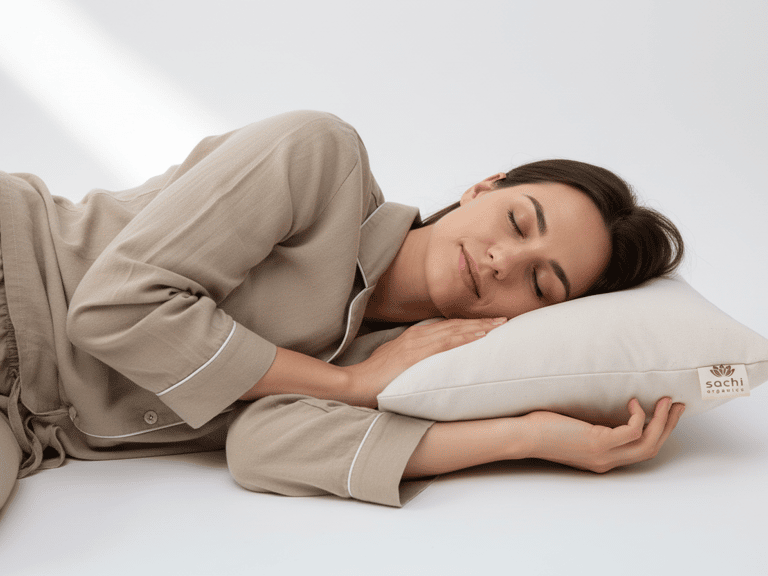
Think about your usual position and the bed beneath you. A side sleeper who places a pillow between the knees may want enough length and loft to keep it from slipping away, while someone who hugs a pillow may care more about softness and ease of compression. People vary in body size, shoulder breadth, mattress firmness, and preferred posture, so a general recommendation can only be a starting point. A pillow that feels supportive to one person may feel intrusive or too lofty to another.
Adjustable fill can make a body pillow more adaptable. A zipper may allow the sleeper to remove some wool, kapok, or shredded latex and tailor the height or density. Yet “adjustable” is not a guarantee of effortless customization. The opening may be small; loose fill can scatter; removing material may be easier than adding it back if no extra fill is supplied. Ask whether the pillow has an inner casing, whether the fill can be replaced, and whether changes can be made without compromising seams or the cover.
Care is part of the materials decision
A body pillow is in regular contact with skin, hair, and bedding. Over time, it may collect perspiration, dust, and ordinary household soil. A washable outer cover can make routine care simpler, but the insert may have stricter limits. Some fills can be spot-cleaned; others should not be washed at all. Latex in particular may require careful handling, while wool often calls for airing and spot treatment rather than a full wash. Follow the manufacturer’s instructions rather than applying one cleaning method to every natural fill.
Before committing, read the instructions in full. Note whether the cover can be removed, whether it can be machine-washed, the recommended water temperature, and whether it should be line-dried. Check whether the pillow itself can be washed or only spot-cleaned. If the pillow is made of multiple chambers, find out whether each part has different instructions. The phrase “easy care” means little without these particulars.
A separate pillow protector may be useful if the construction allows one to fit securely. It can reduce the need to clean the insert and may extend the useful life of the cover. It should not be treated as a substitute for care instructions, and it should not make the pillow so tight that it changes the intended loft. Choose protection that fits without compressing the pillow into a different shape.
Maintenance also includes the quieter work: airing the pillow when the maker permits it, restoring loose fill by hand, and checking seams and zippers. Natural fibers are not immune to wear. Wool can settle, shredded filling can shift, and covers can thin. A clear description of expected settling or replacement parts is a sign that a maker has considered the pillow beyond the moment it leaves the factory.
A practical checklist before you choose
A few precise questions can turn an appealing description into useful information. Keep them close while comparing options:
- What are the outer cover, inner casing, fill, and any additional layers made from?
- Does “organic” describe the cover, the fill, or both, and is the claim supported by a named certification?
- Is the fill wool, solid or shredded latex, kapok, or a blend—and what feel should that construction produce?
- Can the loft or firmness be adjusted, and can fill be removed or replaced?
- What are the pillow’s actual dimensions, and how do they relate to the way you plan to use it?
- Can the cover be removed and washed? What are the care instructions for the insert?
- Are relevant certifications identified clearly, with their scope explained?
- Does the maker disclose sourcing, country of manufacture, warranty terms, and any expected settling?
If the answers are not available online, a direct question to the seller can be revealing—not because a prompt reply proves quality, but because clear, specific answers make an informed decision possible. Vague reassurance is less useful than a plain statement that a component is not certified, cannot be washed, or is made from a blend. Transparency need not make a product perfect; it makes its limits visible.
Comfort is evidence, too
Material claims deserve scrutiny, but the pillow must also work in the ordinary theatre of the night. It should remain where you put it, feel comfortable against your body, and offer a degree of support that does not force you into an awkward position. If there is a trial period, read its terms before use: the time limit, return shipping, hygiene requirements, and any restrictions on opening or adjusting the fill. For a pillow without a trial, dimensions, fill details, and care guidance become especially important.
A body pillow is a comfort aid, not a treatment for a medical condition. Some sleepers find that a pillow between the knees or in the arms makes a preferred position easier to maintain; that personal experience should not be confused with a promise to relieve pain or correct a spinal problem. Persistent pain, numbness, or sleep disruption calls for advice from an appropriate health professional rather than a guarantee printed on bedding packaging.
The phrase “non-toxic body pillow” can suggest a tidy answer to a complicated question. The more useful answer is usually a collection of smaller ones: what the cover contains, what the fill does, how the pillow is built, which claims are certified, how its length and loft meet a particular body, and how it can be kept clean. When those facts are available, a buyer can make a choice without relying on a cloud of adjectives.
That choice need not be a declaration of allegiance to one fiber. A natural latex pillow may be right for someone who prefers buoyant structure; wool may suit a sleeper drawn to a softer, breathable fill; kapok may appeal to someone seeking a light, plant-based feel. Organic cotton can make a reassuring cover, but the whole pillow still deserves inspection. The point is not to find the material that sounds most virtuous. It is to find a well-described pillow whose support, maintenance, and material claims hold together in the life of the bed.